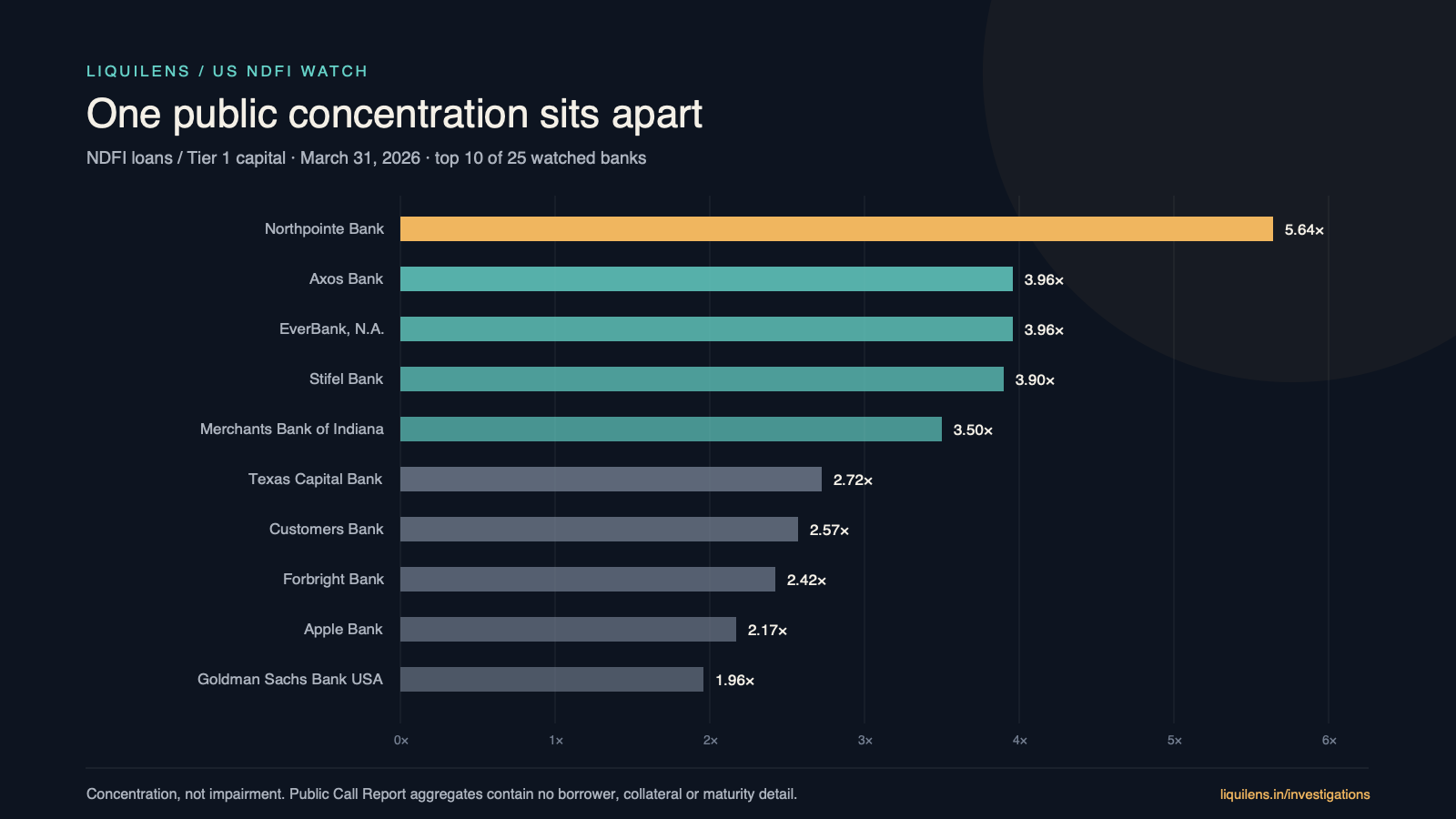
A useful investigation often begins with a number that is both striking and incomplete. In Northpointe Bank’s March call-report data, loans to nondepository financial institutions equal 5.6387 times Tier 1 capital. The next four banks in LiquiLens’s watch sit between 3.50 and 3.96 times. The gap deserves attention. It does not deserve a verdict.
The category can include lending to credit funds, mortgage companies, broker-dealers, insurance-related entities and other financial intermediaries. A dollar of exposure is not a dollar of loss. Without borrower, collateral, maturity and covenant detail, the public ratio cannot tell us whether the book is resilient, hedged, distributed—or fragile.
The finding is not “this bank is in trouble.” The finding is that one public concentration is 42% above the next-highest ratio in the watch, while the evidence needed to judge its quality sits below the aggregate line.
Why divide by Tier 1 capital?
Capital is the loss-absorbing base. Comparing a concentrated loan category with Tier 1 capital asks a simple capacity question: how large is the exposure relative to the buffer designed to absorb unexpected loss? At 5.64×, a small loss rate applied across the category could matter. But the ratio alone supplies neither the loss rate nor the correlation across borrowers.
The denominator also matters. A fast-growing, well-collateralised warehouse business can print a high exposure-to-capital ratio without being impaired. Conversely, low reported delinquencies can lag problems in private structures whose valuations and covenants update slowly. The public table tells us where to ask harder questions, not what the answers are.
The funding model belongs in the same case file
Northpointe’s public row reports brokered deposits equal to 58.61% of deposits and uninsured deposits equal to 7.66%. Those two numbers pull in different directions. A low uninsured share may reduce one familiar run channel. A high brokered share raises a separate question about price sensitivity and renewal. Neither should be silently folded into an allegation.
That is why LiquiLens keeps the components visible. The NDFI ratio identifies asset concentration. Deposit composition describes funding. A risk story requires a mechanism joining them: for example, correlated drawdowns or collateral marks arriving while funding reprices. We do not observe that mechanism in this aggregate release.
THE STRONGEST COUNTER-CASE
NDFI lending may be secured, short-duration, diversified and actively distributed. Northpointe’s relatively low uninsured-deposit share may make its liability base less exposed to the uninsured depositor flight seen in 2023. The 5.64× ratio contains no loan-level loss history, collateral margin, borrower concentration or liquidity schedule. Treating it as a distress signal would outrun the evidence.
The missing document is the next story
A serious follow-up needs the composition of the NDFI book: warehouse lines versus term loans, committed versus funded exposure, top-borrower concentration, collateral type, advance rates, margining frequency, maturities, syndication and risk transfers. It also needs the quarter-to-quarter path on an as-published basis rather than today’s amended history.
Until those pieces exist, the responsible publication is a concentration audit. It names the public ratio, compares like with like, states why it might matter, and publishes the counter-case beside it.
WHAT CHANGES OUR MIND
Detailed evidence of short duration, strong collateralisation, low borrower concentration, conservative advance rates and reliable take-out capacity would weaken the concern raised by the aggregate ratio. Rising nonaccruals, correlated borrower stress or funding repricing would strengthen it. The current record establishes neither.
Sources and method
- LiquiLens public NDFI watch; 25 ranked rows, evidence clocks, provenance and explicit limitations.
- FDIC BankFind: Northpointe Bank, certificate 34953.
- FDIC BankFind Suite; public Call Report and institution data.
- FDIC 2026 Risk Review; system-level discussion of lending to nondepository financial institutions.
Limitations. The data are current-amended construction-PIT, not a complete archive of the values first published each quarter. The 60-day filing lag is a conservative availability proxy. LiquiLens does not publish this as a validated backtest, default forecast, credit rating or real-money signal. No claim of insolvency, misconduct or asset impairment is made. Research and risk screening, not investment advice.